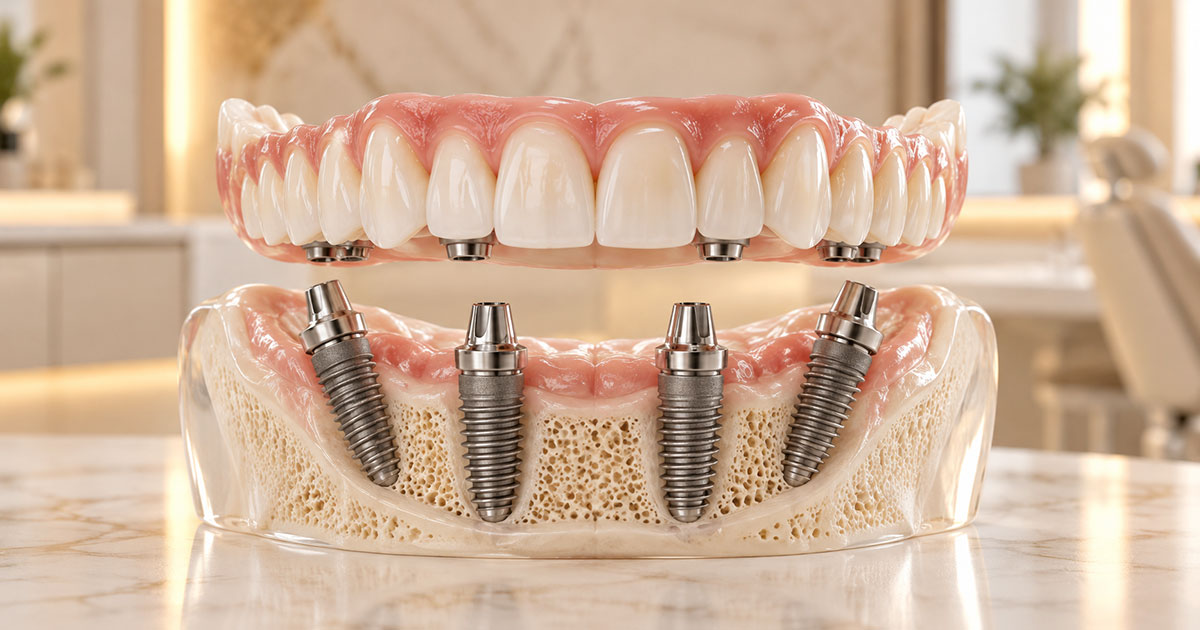
Losing all the teeth in one jaw is not merely a simple aesthetic issue, and many patients seek treatment for complete edentulism. This condition directly affects chewing ability, speech, facial structure, and even self-confidence. In such situations, many patients look for a solution that is fast, stable, and natural-looking. In recent years, All-on-4 implants have been introduced as one of the most advanced methods for full-jaw rehabilitation.
This method uses four implant fixtures to support a full fixed dental arch. For many patients, the outcome of this treatment is achieving fixed teeth in one day. In this article, we will take a closer look at how the four-implant technique works, who the best candidates are, and in which situations alternative methods such as All-on-6 or more advanced techniques may be required. The goal is to ensure that treatment is chosen fully consciously and without error.
How Does the All-on-4 Implant Technique Work?
In the All-on-4 implant technique, four implant fixtures are placed in the jawbone. Two implants are positioned vertically in the front region, while two implants are inserted in the posterior regions at a specific angle.
This smart design helps to:
– distribute chewing forces evenly
– make maximum use of the remaining bone
– reduce the need for complex surgical procedures
For this reason, many patients, even those with moderate bone loss, may still be suitable candidates for this method. The term four-implant treatment refers exactly to this structure. An important point is that using fewer implants does not mean lower quality; rather, it means an engineered design that makes better use of the available bone. In many cases, patients can receive fixed teeth in one day after surgery. This is considered one of the most important advantages of this method.
Who Are the Best Candidates for All-on-4 Implants?
Proper patient selection is the most important factor in treatment success. Not everyone is suitable for this method, but a wide range of patients can benefit from it.
People Who Have Lost All Teeth in One or Both Jaws
The main target group includes patients who have lost all the teeth in one or both jaws. In these cases, All-on-4 implants provide a fixed and stable replacement.
People with Non-Restorable Teeth
If the teeth cannot be saved due to severe decay, dental infection or gum disease, the dentist may decide to extract all remaining teeth and proceed with the four-implant approach.
Patients with Moderate Bone Loss
One of the strengths of this method is its efficient use of the remaining bone. In many cases, bone grafting is not required, which allows treatment to be completed more quickly.
People Looking for a Fast Result
Patients who do not want to remain without teeth for a long period often seek fixed teeth in one day. This method is specifically designed to meet that need. However, whether fixed teeth can actually be delivered in one day depends on the condition of the jawbone and the dentist’s clinical judgment.
If you want, I can also translate the rest of the article in the same website-friendly style.
What Is the All-on-4 Implant Technique and Who Is It Suitable For?